
Geode: What It Is, How It Forms and What It's Worth
Quick answer
A geode is a hollow, roughly round rock lined with crystals that grow inward. How it forms, how rare it is, and FossilEra prices from US$5 (2026-09-25).
Updated 2026-09-25 · Sources: Illinois State Geological Survey (via Project Gutenberg), Wikipedia, uky.edu, iowageologicalsurvey.uiowa.edu
Found one? Take a photo to identify it.
Download on the App StoreWhat are the key facts?
- Type: Structure (a rock body with an internal cavity)
What Geode looks like
The sources we opened give only tests and comparisons for Geode, not a full property list; see below.
Tests you can do at home
- Weight test (to judge whether an uncut geode is hollow): for the same size, a hollow geode lined with crystals is noticeably lighter than a solid nodule.
- Interior minerals: the most common mineral inside geodes is quartz (including colorless clear crystal, milky quartz, and smoky-to-brown smoky quartz); calcite, aragonite, dolomite, siderite, pyrite, galena, fluorite, and sphalerite also occur. Safety: When cutting or cracking open a geode, wrap it in a damp cloth and work on a stable surface with a hammer and chisel, wearing eye protection and gloves. If using a bench saw or rock saw, follow the manufacturer's instructions and wear protective gear to guard against flying debris and blade injuries.
Often confused with
- Ordinary Nodule / Solid Cobble: Weigh it in your hand: a hollow geode is noticeably lighter; a solid nodule or cobble is heavier.
Where it is found in North America
Illinois (and the surrounding Keokuk/Mississippi River Valley area), a well-known geode locality in the American Midwest.
How to photograph it for identification
Photograph a fresh, unweathered surface in daylight, then a second shot of any crystal faces or broken edge. Include a coin for scale. If you did a streak test, photograph the streak next to the specimen. The app suggests the likely mineral or rock; confirm with hardness and the tests above before you label it.
Notes on this entry
A geode is not a mineral but a rounded or oval rock structure containing an internal cavity, often lined with crystals. Mineralogical fields such as Mohs hardness, streak, and luster do not apply and are uniformly left blank.
What is a geode?
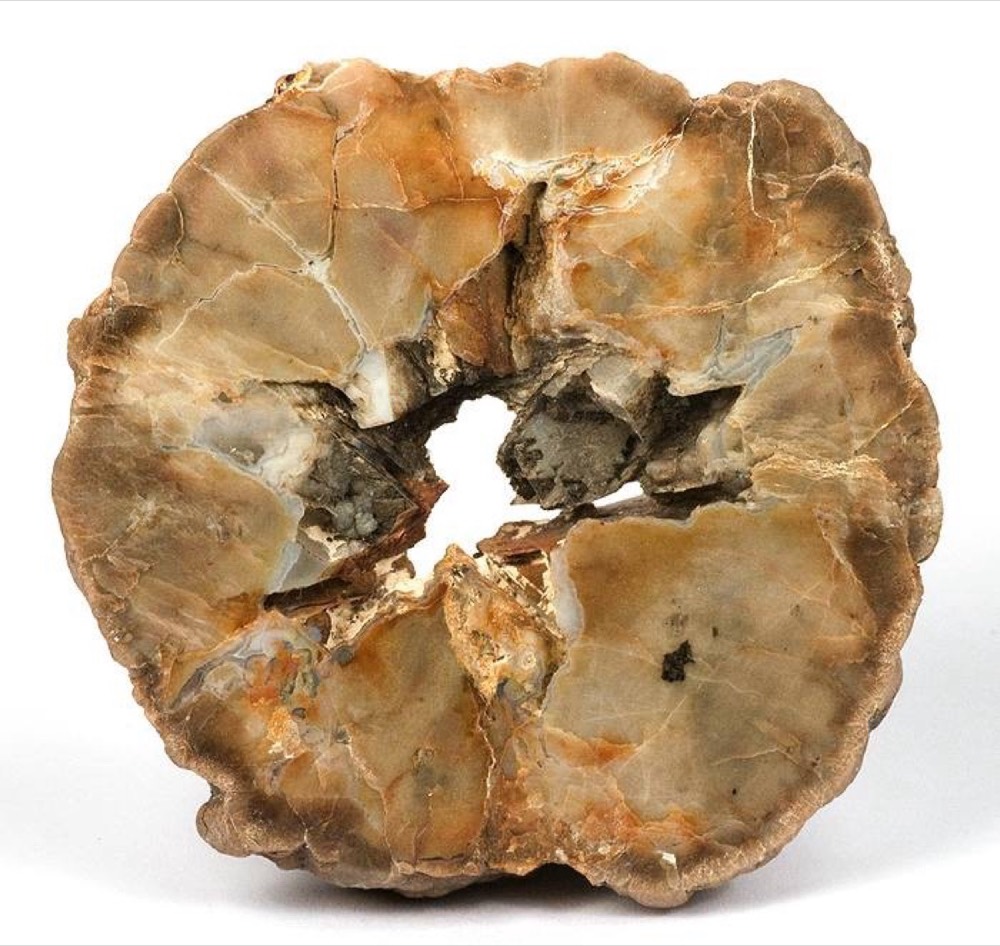
A geode is a hollow, roughly spherical rock found in sedimentary and volcanic rock, with crystals lining the cavity and growing inward. The word comes from the Ancient Greek for "earthlike", according to Wikipedia's entry.
The Kentucky Geological Survey draws the line that matters for identification: geodes are hollow and their crystals grow inward from an outer shell, while concretions are solid and grow outward from a central core. If a round rock is solid all the way through, it is a nodule or thunderegg, not a geode.
How a geode forms
Wikipedia describes two routes. In volcanic rock, gas bubbles (vesicles) in lava leave cavities that hydrothermal fluids later fill with minerals, which is how the large amethyst geodes of the Brazil and Uruguay basalts formed. In sedimentary rock, a rounded cavity forms first; once the surrounding rock hardens, dissolved silica or carbonate is deposited on the inside surface, layer on layer, until crystals grow into the space.
The Kentucky survey adds that the outer rind is usually quartz of the chalcedony variety, with crystals growing inward from it. In Iowa, the state survey traces its famous geodes to the lower Warsaw Formation, a rock unit of Mississippian age.
Is a geode worth anything?
Most geodes are worth a few dollars to a few tens of dollars; large, well-crystallised ones on stands reach thousands. Dealer asking prices on FossilEra, checked 2026-09-25:
- Unopened quartz geode, Morocco, 3–4 in: US$5
- Keokuk geode pairs with calcite, Missouri, 2.3–2.6 in: US$22–27
- Amethyst geode, Uruguay, 3.9 in: US$29
- Polished half of a crystal-filled Dugway geode, Utah, 4.9 in: US$79
- Amethyst geode on a metal stand, Uruguay, 10.3 in: US$295
- Dark purple amethyst geode on a stand, Uruguay, 14.2 in: US$3,555
- Giant quartz geode display, 50 in: US$22,500
These are asking prices, not sales. What moves the price is crystal colour and size, whether the cavity is intact, whether it has been dyed, and the locality. Wikipedia notes that some geodes are dyed in bright colours such as electric blue or pink, which do not form naturally.
How rare is a geode?
Geodes are not rare as a group; they are local. The Iowa Geological Survey says the most productive area lies within a 35-mile radius of Keokuk, especially Lee, Henry and Van Buren counties, and Iowa made the geode its official State Rock in 1967. Wikipedia lists Brazil, Uruguay, Namibia and Mexico as major sources, and Indiana, Iowa, Missouri, Illinois, Kentucky and Utah in the United States.
What is uncommon is the interior. The Kentucky survey says most geodes are lined with quartz, and less often with calcite or dolomite, sometimes with barite, galena, fluorite, sphalerite, pyrite, selenite or celestite. The Iowa survey records 17 minerals in Keokuk geodes beyond quartz and calcite.
What do geodes mean spiritually?
Crystal sellers describe geodes as amplifying the energy of the crystals inside; that is a belief, not a geological property. Wikipedia's article on crystal healing summarises the evidence plainly: there is no peer-reviewed scientific evidence that it has any effect, and a 2001 study found participants reported the same experiences with real crystals and with indistinguishable fakes. Enjoy a geode for what it demonstrably is: a record of mineral-rich water filling a cavity over a very long time.
Gemstones found in geodes
The gemstones found in geodes are almost all varieties of quartz: amethyst, clear rock crystal, smoky quartz, citrine, agate and chalcedony. Wikipedia counts amethyst and quartz varieties as gemstones, and notes amethyst was once considered precious until large Brazilian finds in the 19th century made it common.
Geodes also hold minerals that collectors prize but jewellers rarely use. The Kentucky Geological Survey lists calcite, dolomite, barite, galena, fluorite, pyrite, sphalerite, selenite and celestite alongside quartz. Most are soft, calcite at 3 and fluorite at 4, and Wikipedia notes soft minerals are not typically used as gemstones because they wear and break easily.
Diamonds, rubies and sapphires are not on any geode mineral list we opened; see our types of geodes page for what the surveys do list.
Geode or gemstone: the difference
A geode is a structure; a gemstone is a use. Wikipedia defines a geode as a hollow, roughly spherical rock containing mineral deposits or crystals, and a gemstone as mineral crystal that is cut or polished for jewellery or other adornment.
So a geode can contain gem material, and a gemstone can be cut from a geode, but most geodes are sold whole. Amethyst geodes are sold whole as display pieces, and the solid agate cores of Las Choyas geodes go to the lapidary trade for cabochons, as our unopened geodes page notes. If a rock is completely solid inside, Wikipedia classes it as a nodule or thunderegg, not a geode.
What gem-lined geodes cost
Gem Avenue, a geode retailer, listed 29 geodes from US$38 to US$799 on 25 September 2026. Examples:
- Amethyst heart geode, 3 inches: US$38.
- Black amethyst geode, 6 inches: US$149.
- Citrine geode cluster, 9 inches, Brazil: US$199. Most yellow citrine geodes are heat-treated amethyst; see our citrine geode page.
- Uruguayan amethyst geode, 11 inches: US$399.
These are asking prices for display pieces. A plain quartz geode you crack yourself costs a few dollars, as our unopened geodes page shows.
About this update
The sections added on 25 September 2026 were researched and drafted with AI assistance and checked line by line against the sources listed on this page. Prices are retailer asking prices seen on that date, not appraisals.
FAQ
How do I tell Geode from Ordinary Nodule / Solid Cobble?
Weigh it in your hand: a hollow geode is noticeably lighter; a solid nodule or cobble is heavier.
What is the simplest test for Geode?
Weight test (to judge whether an uncut geode is hollow): for the same size, a hollow geode lined with crystals is noticeably lighter than a solid nodule.
What is a geode?
A hollow, roughly spherical rock whose cavity is lined with crystals growing inward, most often quartz. Geodes form in volcanic and sedimentary rock. If the inside is solid, it is a nodule or thunderegg instead.
Is a geode worth anything?
Usually a little. On FossilEra on 2026-09-25, an unopened 3–4 inch Moroccan quartz geode was listed at US$5 and a 3.9 inch Uruguayan amethyst geode at US$29, while a 14.2 inch amethyst geode on a stand was US$3,555. Colour, crystal size, an intact cavity and no dye push the price up.
How rare is a geode rock?
Not rare, but concentrated in certain places: the Keokuk area of Iowa, Illinois and Missouri, Kentucky, Indiana and Utah in the US, and Brazil, Uruguay, Namibia and Mexico abroad. Unusual interior minerals such as celestite or sphalerite are the rarer finds.
What do geodes mean spiritually?
Sellers attach meanings such as amplifying energy, but these are beliefs with no scientific support; research on crystal healing found no effect beyond placebo. Geologically, a geode records mineral-rich water slowly filling a cavity.
What gemstones are found in geodes?
Mostly quartz varieties: amethyst, clear quartz, smoky quartz, citrine, agate and chalcedony. Geodes also hold softer collector minerals such as calcite, fluorite and celestite, which are rarely cut as gems.
What is the difference between a gemstone and a geode?
A geode is a hollow rock lined with crystals; a gemstone is a mineral cut or polished for jewellery. A geode can contain gem material, such as amethyst, but most geodes are sold whole rather than cut.
How can you tell if a stone is a geode?
Look for a round stone with a bumpy rind that feels heavier than an ordinary limestone cobble of the same size (RockHounding.org). Whether it turns out hollow or solid inside, you can only tell by opening it; many geodes are solid throughout (Iowa Geological Survey).
Are amethyst geodes worth more than plain quartz geodes?
Usually. On 25 September 2026 Gem Avenue asked US$38 for a 3-inch amethyst geode and US$399 for an 11-inch Uruguayan one, while plain quartz geodes to crack yourself cost a few dollars.
More in Rock and Mineral Identification Reference
Related
See what's actually under your feet.
Start with a single scan.
Found one? Take a photo to identify it.
Sources
- Illinois State Geological Survey (via Project Gutenberg)www.gutenberg.org/files/66308/66308-h/66308-h.htm
- Wikipediaen.wikipedia.org/wiki/Geode
- uky.eduwww.uky.edu/KGS/rocksmineral/rm-rocks-geodes.php
- iowageologicalsurvey.uiowa.eduiowageologicalsurvey.uiowa.edu/iowa-geology/popular-interest/iowa-geodes
- fossilera.comwww.fossilera.com/minerals-for-sale/geodes
- Wikipediaen.wikipedia.org/wiki/Crystal_healing
- Wikipediaen.wikipedia.org/wiki/Gemstone
- gemavenue.comgemavenue.com/collections/geodes
Compiled by the RockLens editorial team
Every fact on this page is taken from the sources listed above; numbers and prices are copied from the source, and prices name the guide or auction and its date. Research and drafting were assisted by AI, and each claim was then checked against the cited sources. Checked 2026-09-25. We do not buy, sell or grade items; the app identifies what you photograph and points you to these references.